by Ibrahim Ahmad for the Clay-Gilmore Institute for Philosophy, Technology, and Counterinsurgency
The United States government does not officially track who police kill, and this is not an accident of bureaucratic neglect but a condition that has persisted across four decades and multiple administrations, despite the fact that the country maintains detailed federal records on virtually every other significant cause of death. Between 1980 and 2018, the National Vital Statistics System missed 55.5 percent of all police violence deaths, and for Black Americans the miss rate reached 59.5 percent, meaning that nearly three in five Black people killed by police during those forty years were not counted in the official record at all. That absence is where this essay begins, because what follows is not only an argument about racial disparity in American police violence but about why the institution producing that disparity is also the institution charged with recording it, and why the decision not to count is inseparable from the capacity to continue without consequence.
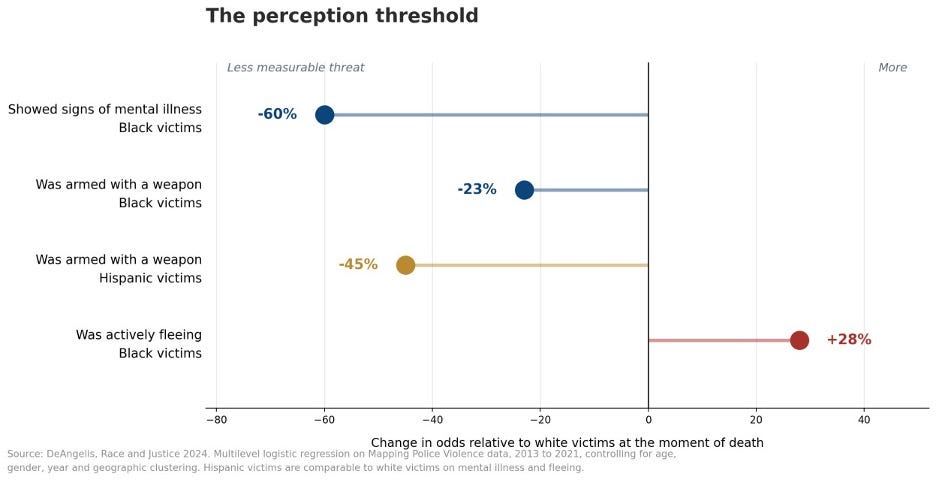
What the data reveals, across more than fifteen thousand documented killings since 2013, is that American policing operates through a threshold for perceived dangerousness that is demonstrably lower for Black and Latino civilians than for white civilians at the same or greater levels of objective threat, that the resulting deaths fall overwhelmingly on men, and that both the legal standard governing use of force and the federal apparatus for recording it are built in ways that make this pattern unreviewable. The claim of this essay is that these are not three problems but one, and that the frame which makes them a single problem is counterinsurgency, a doctrine that sorts populations into those who must be neutralised and those who must be won, that has always performed that sorting along lines of sex, and that requires the sorting to remain unexamined in order to keep claiming it is precise.
I. The raw toll
Mapping Police Violence reports that Black people are 13 percent of the American population and 28.2 percent of those killed by police once cases of unknown race are set aside, which makes Black Americans 2.9 times more likely to be killed than white Americans. Since the database is between 91 and 94 percent male depending on the year, Black men alone account for roughly a quarter of all victims while being about six percent of the country. Latino men account for something close to a fifth. Women of every race together account for between six and nine percent, against a population share of fifty-one percent. White people remain the largest single group of victims in raw numbers while carrying the lowest per-capita risk, which is why the racial claim in this essay rests on rates rather than totals. And Mapping Police Violence codes roughly two percent of victims as transgender, a category the sex-based analysis below does not resolve and should not be read as dismissing.
Proportions, however, have a way of flattening what they describe. Mapping Police Violence has...